

Hey there! As a supplier of YAG rods, I've gotten tons of questions from folks about controlling the pulse duration of a YAG rod laser. It's a super important topic, especially for those who use these lasers in various applications like material processing, medical treatments, and scientific research. So, let's dive right into it and explore how we can control that pulse duration.
First off, what exactly is pulse duration? In simple terms, it's the length of time that the laser pulse is "on." It can range from femtoseconds (that's a really, really short time!) to milliseconds. The pulse duration can have a huge impact on the laser's performance and the results of its applications.
One of the most common ways to control the pulse duration is through Q-switching. Q-switching is a technique that allows us to store energy in the laser medium (in our case, the YAG rod) and then release it in a short, high-energy pulse. There are different types of Q-switches, like electro - optical Q-switches and acousto - optical Q-switches.
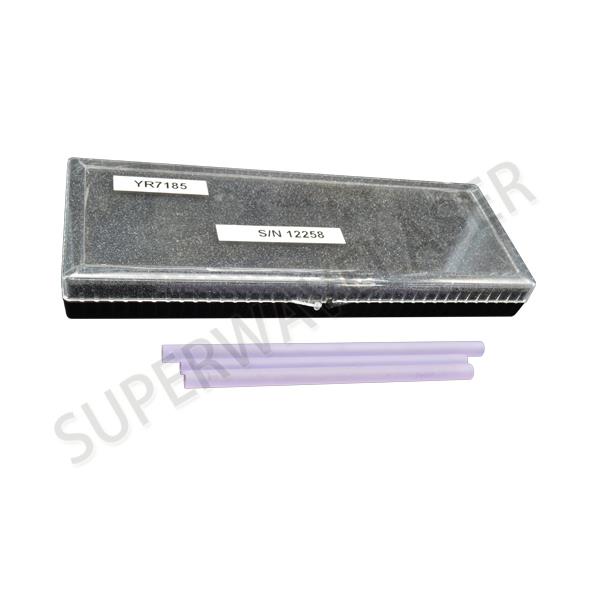
Electro - optical Q-switches work by using an electro - optical crystal. When an electric field is applied to the crystal, it changes the polarization of the light passing through it. By controlling the electric field, we can control when the energy stored in the YAG rod is released. This way, we can adjust the pulse duration. For example, if we want a shorter pulse, we can release the stored energy more quickly.
Acousto - optical Q-switches, on the other hand, use sound waves. When a sound wave is applied to a crystal, it creates a diffraction grating. This grating can either allow the light to pass through or diffract it. By controlling the sound wave, we can control the release of energy from the YAG rod and thus the pulse duration.
Another method to control the pulse duration is through mode - locking. Mode - locking is a technique that forces all the longitudinal modes of the laser to oscillate in phase. This results in a train of very short pulses. There are different types of mode - locking, such as passive mode - locking and active mode - locking.
Passive mode - locking uses a saturable absorber. A saturable absorber is a material that absorbs light at low intensities but becomes transparent at high intensities. As the laser builds up energy, the saturable absorber becomes transparent, allowing the energy to be released in a short pulse. Active mode - locking, on the other hand, uses an external modulator to control the phase of the laser modes.
The properties of the YAG rod itself also play a big role in controlling the pulse duration. The length of the YAG rod can affect the amount of energy that can be stored in it. A longer rod can store more energy, which can potentially lead to longer pulse durations. The doping concentration of the YAG rod is also important. A higher doping concentration can increase the gain of the laser, which can affect the pulse duration.
When choosing a YAG rod for a specific application, it's crucial to consider these factors. For example, if you need a short - pulse laser for precision material processing, you might want a YAG rod with a lower doping concentration and a shorter length.
Now, let's talk about the importance of the quality of the YAG rod. A high - quality YAG rod is essential for controlling the pulse duration accurately. A rod with good optical quality will have fewer defects, which means less scattering and absorption of the laser light. This can lead to more stable and predictable pulse durations.
As a YAG rod supplier, we take great pride in providing high - quality YAG rods. Our rods are carefully manufactured to ensure the best optical properties. We also offer a wide range of YAG rods with different lengths, doping concentrations, and other specifications to meet the diverse needs of our customers.
If you're interested in learning more about YAG rods and how they can be used to control the pulse duration of a laser, you can check out our Laser Crystal page. It has a lot of useful information about different types of laser crystals, including YAG rods.
In conclusion, controlling the pulse duration of a YAG rod laser is a complex but achievable task. By using techniques like Q - switching and mode - locking, and by choosing the right YAG rod with the appropriate properties, you can get the pulse duration you need for your specific application.
If you're in the market for YAG rods or have any questions about controlling the pulse duration of a YAG rod laser, don't hesitate to reach out. We're here to help you find the best solutions for your laser needs.
References
- "Laser Physics" by W. T. Silfvast
- "Handbook of Laser Technology and Applications" edited by Peter R. Herman


