

Hey there! As a supplier of YAG rods, I'm super stoked to share with you how these little wonders work in a laser system. You might be wondering what a YAG rod is in the first place. Well, YAG stands for yttrium aluminum garnet, and it's a crystal that plays a crucial role in many laser setups.
Let's start with the basics. In a laser system, the main goal is to generate a concentrated beam of light. And that's where the YAG rod comes in. It's like the heart of the laser, where all the action happens. The YAG rod is doped with certain elements, usually neodymium (Nd), which gives it some pretty amazing properties.
When you pump energy into the YAG rod, it gets excited. This energy can come from different sources, like flash lamps or diode lasers. The pumping process is like giving the YAG rod a big energy boost. The neodymium ions in the rod absorb this energy and jump to a higher energy level.
Once these ions are in the higher energy state, they're not going to stay there forever. They'll eventually drop back down to a lower energy level, and when they do, they release a photon. This photon is a particle of light, and it's the building block of the laser beam.
But here's the cool part. In a laser system, we don't just want random photons flying everywhere. We want them to be in sync and traveling in the same direction. That's where the optical cavity comes in. The YAG rod is placed inside an optical cavity, which is basically a set of mirrors at each end.
One of the mirrors is fully reflective, and the other is partially reflective. When the photons are released in the YAG rod, they bounce back and forth between these mirrors. As they bounce, they stimulate other excited neodymium ions to release more photons. This process is called stimulated emission, and it's what makes the laser beam so powerful and focused.
With each pass through the YAG rod, more and more photons are generated, and the beam gets stronger and stronger. Eventually, some of the photons pass through the partially reflective mirror, and that's the laser beam that comes out of the system.
Now, why is the YAG rod so special? Well, it has a few key advantages. First of all, it can operate at different wavelengths, depending on the doping and the design of the laser system. This makes it very versatile and useful for a wide range of applications.
For example, in medical applications, YAG lasers are used for things like eye surgery and skin treatments. The precise and powerful beam can be used to target specific tissues without causing too much damage to the surrounding area. In industrial applications, YAG lasers are used for cutting, welding, and marking materials. They can cut through thick metals and create very precise patterns.
Another advantage of the YAG rod is its high efficiency. It can convert a large percentage of the input energy into laser light, which means less energy is wasted. This is important for both cost - effectiveness and environmental reasons.
If you're interested in learning more about the different types of laser crystals, you can check out this page Laser Crystal. It has a lot of great information about the various crystals used in laser systems.
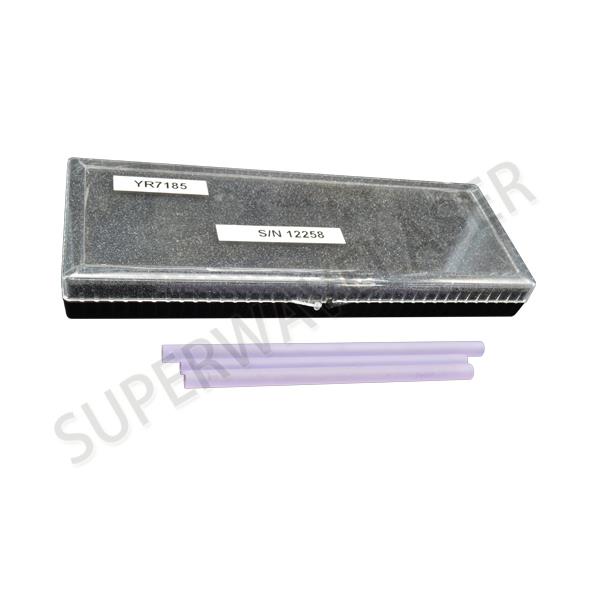
When it comes to choosing a YAG rod for your laser system, there are a few things to consider. The size of the rod is important. A larger rod can generally produce a more powerful laser beam, but it also requires more energy to pump. The doping concentration is also crucial. Different doping levels can affect the performance and the wavelength of the laser.
At our company, we offer a wide range of YAG rods with different sizes and doping levels. We understand that every laser system is unique, and we're committed to providing the best products to meet your specific needs.
If you're in the market for a YAG rod or have any questions about how they work in your laser system, don't hesitate to reach out. We're here to help you find the perfect solution for your application. Whether you're a researcher working on a new laser technology or an industrial manufacturer looking to upgrade your equipment, we've got you covered.
In conclusion, the YAG rod is a vital component in a laser system. It's responsible for generating the powerful and focused laser beam that we use in so many different fields. Its unique properties make it a popular choice for a wide range of applications, and its efficiency and versatility make it a great investment. So, if you're looking to take your laser system to the next level, consider using a high - quality YAG rod from us.
References
- "Laser Physics" by W. T. Silfvast
- "Handbook of Laser Technology and Applications" edited by C. Breckinridge


